
Introduction
When business owners think about their IT infrastructure, they typically think about software, servers, and internet speed. Very few think about the physical cabling that connects it all together — until something goes wrong.
Poor cabling is responsible for a surprising number of network performance problems, outages, and security vulnerabilities. Substandard or improperly installed wiring creates interference, limits speed, and creates maintenance nightmares as businesses grow.
Structured cabling is the systematic, standards-based approach to designing and installing your network’s physical wiring infrastructure. Done right, it’s the foundation that allows everything else — your internet, your servers, your VoIP phones, your security cameras — to perform at full capability.
Data Safe Group provides professional structured cabling services throughout Morris County and NJ, including Cat6, fiber optic, and cable testing.
What Is Structured Cabling?
Structured cabling is a comprehensive, organized system of cabling and associated hardware that provides a reliable telecommunications infrastructure for a building or campus. Rather than running cables ad hoc as technology needs arise, structured cabling creates a planned, organized system built to industry standards (TIA/EIA-568) that can support a wide range of applications.
A structured cabling system includes:
- Horizontal cabling — cables running from wall outlets to a central distribution point (patch panel)
- Vertical/backbone cabling — cables connecting equipment rooms, floors, and buildings
- Patch panels — organized termination points that make moves, adds, and changes simple
- Cable management — trays, racks, and labels that keep everything organized and documented
- Work area components — wall plates, jacks, and patch cords at each workstation
When properly installed, a structured cabling system can support voice, data, video, and even building automation systems — all from the same physical infrastructure.
Cat6 vs. Fiber Optic: Which Cabling Is Right for Your Business?
The two most common cabling types Data Safe Group installs for NJ businesses are:
Cat6 (Category 6) Cabling is the current standard for most office and commercial installations. Cat6 supports speeds up to 10 Gigabits per second over shorter distances and is ideal for most small and mid-sized business environments. It’s reliable, cost-effective, and supports every current networking standard. Cat6a extends performance even further.
Fiber Optic Cabling uses light rather than electrical signals to transmit data. Fiber supports much higher speeds over much longer distances and is immune to electrical interference. It’s the preferred choice for backbone runs between floors or buildings, high-performance environments (such as server rooms and data centers), and situations where cables run through electrically noisy environments.
For most Morris County small businesses, Cat6 is the right choice for workstation connections, with fiber optic used for backbone infrastructure. Data Safe Group assesses your specific environment and recommends the right combination.
Signs Your Current Cabling Is Hurting Your Business
Many businesses don’t realize their cabling is a problem until they start looking. Common warning signs include:
- Unexplained network slowdowns that don’t improve with a faster internet plan
- Frequent network disconnections at specific workstations
- Poor performance on specific segments of the network
- Cables running visibly along walls, under carpet, or through makeshift paths
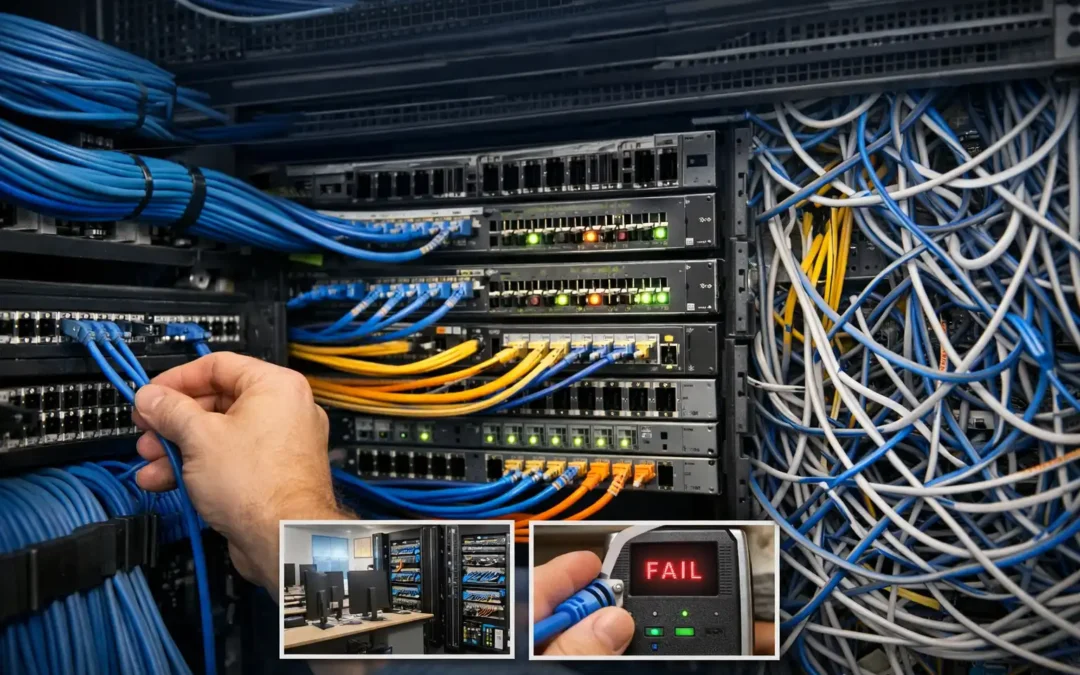
- No documentation of what connects where — a tangle of unlabeled cables in the server room
- Network performance that can’t support new technology additions
- Frequent cable-related failures as your infrastructure ages
If any of these sound familiar, a cabling assessment from Data Safe Group is a practical first step.
The Business Case for Professional Structured Cabling
Professional structured cabling is an investment that pays off in multiple ways:
Reliability — Properly installed, tested cabling performs consistently. Every run is tested to standard after installation, and documentation means troubleshooting is fast when issues occur.
Scalability — Structured cabling systems are designed to accommodate growth. Adding workstations, phones, or network devices doesn’t require new cable runs every time.
Performance — A professionally installed Cat6 system delivers consistently better performance than improvised cabling — even with the same internet speed and networking equipment.
Lower Long-Term Costs — Documented, organized cabling dramatically reduces the cost of moves, adds, and changes. IT teams spend far less time tracing cables and troubleshooting connections.
Code Compliance — Professional installation ensures your cabling meets building codes and fire safety requirements — something DIY and low-bid installations often overlook.
Data Safe Group’s Structured Cabling Services
Data Safe Group provides end-to-end structured cabling services for NJ businesses:
- Site assessment and design — We evaluate your current infrastructure and design a system that meets your current needs and future growth
- Cat6 and Cat6a installation — Standards-based horizontal cabling for workstations, phones, and access points
- Fiber optic installation — Backbone and high-performance runs for demanding environments
- Cable testing and certification — Every run tested to TIA/EIA standards and documented
- Patch panel installation and labeling — Organized termination with full documentation
- Cable management — Clean, professional installations with proper routing and management
- Network rack installation — Professional server rack installation and organization
- Project management — Full project oversight from design through completion and documentation
Frequently Asked Questions
Q: What is structured cabling?
A: Structured cabling is a standardized, organized system of network wiring and components that provides reliable telecommunications infrastructure for a building, designed to support voice, data, and video applications.
Q: What is the difference between Cat5e, Cat6, and Cat6a cabling?
A: Cat5e supports up to 1 Gbps. Cat6 supports up to 10 Gbps over shorter distances. Cat6a supports 10 Gbps over longer distances. For most current installations, Cat6 or Cat6a is recommended.
Q: When should a business use fiber optic cabling?
A: Fiber optic is recommended for backbone cabling between floors or buildings, in electrically noisy environments, and for high-performance applications like data centers and high-speed server connections.
Q: How long does a structured cabling installation take?
A: Timeline depends on the size and complexity of the project. Most small business installations are completed in one to three days. Data Safe Group provides detailed project timelines during the planning phase.
Q: Does structured cabling need to be certified after installation?
A: Yes. Professional installations include cable testing and certification to TIA/EIA standards, providing documentation that every run meets performance specifications.
Q: How do I get a structured cabling quote for my NJ business?
A: Contact Data Safe Group at (973) 814-9968 or datasafellc.com/contact-us for a site assessment and professional quote.
Build a network infrastructure that’s ready for anything. Contact Data Safe Group for a structured cabling assessment: datasafellc.com/contact-us or (973) 814-9968.