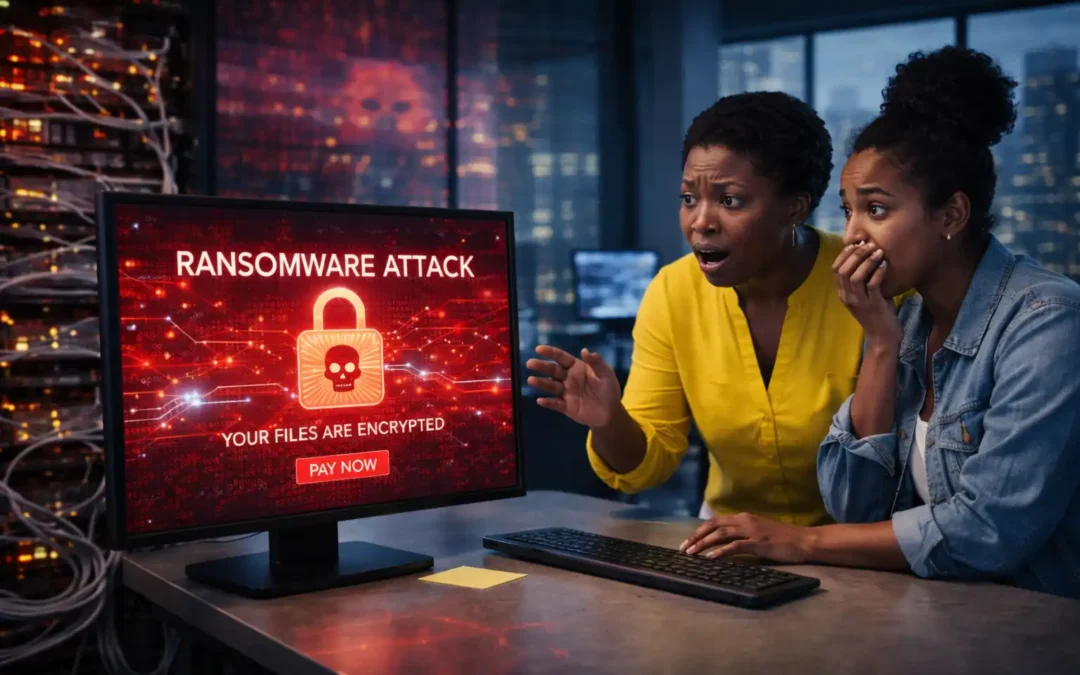
Ransomware is one of the most destructive and fastest-growing cyber threats facing small businesses in New Jersey today. In a ransomware attack, criminals infiltrate your network, encrypt your files, and demand payment — often tens of thousands of dollars — in exchange for restoring access. Many victims pay the ransom and still don’t fully recover their data.
If you run a small or mid-sized business in Morris County or anywhere in NJ, you are a target. Ransomware groups specifically seek out small businesses because they tend to have weaker defenses than large corporations, yet still hold valuable data and have the financial means to pay.
This guide explains how ransomware works, what it costs, and — most importantly — how to protect your business before an attack happens.
How Ransomware Works: A Step-by-Step Breakdown
Understanding how ransomware operates is the first step toward defending against it. A typical ransomware attack follows this sequence:
- Initial Access — Attackers gain entry through a phishing email, a compromised password, an exposed remote desktop connection, or an unpatched software vulnerability.
- Reconnaissance — Once inside, attackers quietly explore your network for days or weeks, identifying critical files, backup systems, and security gaps.
- Lateral Movement — Attackers move across your network, escalating privileges and spreading their foothold to as many systems as possible.
- Encryption — When ready, the ransomware executes and encrypts your files, making them inaccessible. This can happen across your entire network in minutes.
- Ransom Demand — You receive a message demanding payment (usually in cryptocurrency) in exchange for the decryption key.
The most dangerous aspect of modern ransomware is step 2 and 3 — attackers can be inside your network for weeks before you know anything is wrong. That’s why detection matters as much as prevention.
The Real Cost of a Ransomware Attack on a Small Business
Many business owners assume ransomware is a big-company problem. The reality is that small businesses are disproportionately affected because they have fewer resources to recover.
The costs of a ransomware attack extend well beyond the ransom itself:
- Downtime costs — Every hour your systems are offline costs your business in lost productivity, missed revenue, and frustrated customers. For many small businesses, even a single day of downtime can mean $10,000 or more in losses.
- Data recovery costs — Even if you pay the ransom, data recovery is rarely complete. IT forensics, reconstruction, and validation take time and money.
- Regulatory penalties — If your business handles sensitive data (medical records, financial information, personal data), a breach can trigger regulatory fines under HIPAA, PCI DSS, or state laws.
- Reputation damage — Customer trust is hard to rebuild after a publicized breach.
- Cyber insurance deductibles — Even insured businesses face significant out-of-pocket costs.
According to industry research, the average total cost of a ransomware attack for a small business exceeds $200,000 when all factors are considered — far more than the cost of prevention.
Why NJ Small Businesses Are Prime Targets
Ransomware groups are strategic. They target businesses that are most likely to pay and least likely to fight back effectively. Small and mid-sized businesses in New Jersey often fit this profile for several reasons:
- They handle valuable data (client records, financial files, healthcare information) but lack enterprise security infrastructure.
- They often rely on a single IT person or a basic antivirus solution that isn’t built for modern threats.
- They’re less likely to have a formal incident response plan.
- Remote work has expanded attack surfaces significantly, with employees accessing company systems from home networks and personal devices.
The good news: with the right protection in place, small businesses can defend against ransomware as effectively as large enterprises — without an enterprise-sized budget.
How Data Safe Group Protects NJ Businesses From Ransomware
Data Safe Group’s ransomware protection strategy is multi-layered, because no single tool or approach stops every threat. Our protection framework includes:
- Managed Detection and Response (MDR) — We monitor your network 24/7 for indicators of compromise, catching attacks in the reconnaissance or lateral movement phase — before encryption begins.
- Security Operations Center (SOC) — Our fully staffed SOC provides around-the-clock threat monitoring and response.
- Endpoint Protection — Advanced endpoint detection and response (EDR) tools on every device, going far beyond traditional antivirus.
- Email Security — Filtering and sandboxing to catch phishing emails before they reach your employees.
- Backup and Business Continuity — Immutable, offsite backups that ransomware cannot reach or encrypt, allowing rapid recovery even if an attack succeeds.
- Employee Security Awareness Training — Your staff are your first line of defense. We help you train them to recognize and report threats.
- Patch Management — Keeping all software and systems updated to close the vulnerabilities attackers exploit most.
What To Do If You Suspect a Ransomware Attack Right Now
If you believe your systems are currently under attack or have been compromised:
- Disconnect affected systems from the network immediately — unplug ethernet cables and disable Wi-Fi. Do not shut down the machines (forensic evidence may be lost).
- Do not pay the ransom without consulting a cybersecurity professional. Payment does not guarantee recovery and may make you a repeat target.
- Contact your MSP or IT security provider immediately. If you’re a Data Safe Group client, call us at (973) 814-9968 right now.
- Notify your cyber insurance provider to begin the claims process.
- Preserve all evidence for forensic investigation and potential law enforcement reporting.
Speed matters. The faster you act, the more data and systems can be saved.
Frequently Asked Questions
Q: What is ransomware?
A: Ransomware is malicious software that encrypts a victim’s files and demands payment in exchange for the decryption key. Attackers typically demand cryptocurrency and threaten to publish or permanently delete data if not paid.
Q: How do ransomware attacks start?
A: Most ransomware attacks begin with phishing emails, compromised passwords, or unpatched software vulnerabilities. Attackers exploit these entry points to gain initial access to a network.
Q: Can small businesses in NJ really be targeted by ransomware?
A: Yes — small and mid-sized businesses are frequent targets because they hold valuable data but typically have weaker defenses than large enterprises.
Q: Should I pay the ransom if my business is attacked?
A: Cybersecurity experts and law enforcement generally advise against paying the ransom. Payment does not guarantee data recovery, may fund criminal activity, and can identify you as a willing payer for future attacks.
Q: What’s the best way to protect my business from ransomware?
A: A multi-layered approach is most effective: 24/7 network monitoring, endpoint detection, email filtering, regular patching, employee training, and reliable, tested backups.
Q: How can Data Safe Group help protect my NJ business from ransomware?
A: Data Safe Group provides comprehensive ransomware protection including MDR, SOC operations, backup and recovery, and employee security training. Contact us at (973) 814-9968 for a free security assessment.
Don’t wait for an attack to act. Contact Data Safe Group for a free ransomware readiness assessment: datasafellc.com/contact-us or (973) 814-9968.